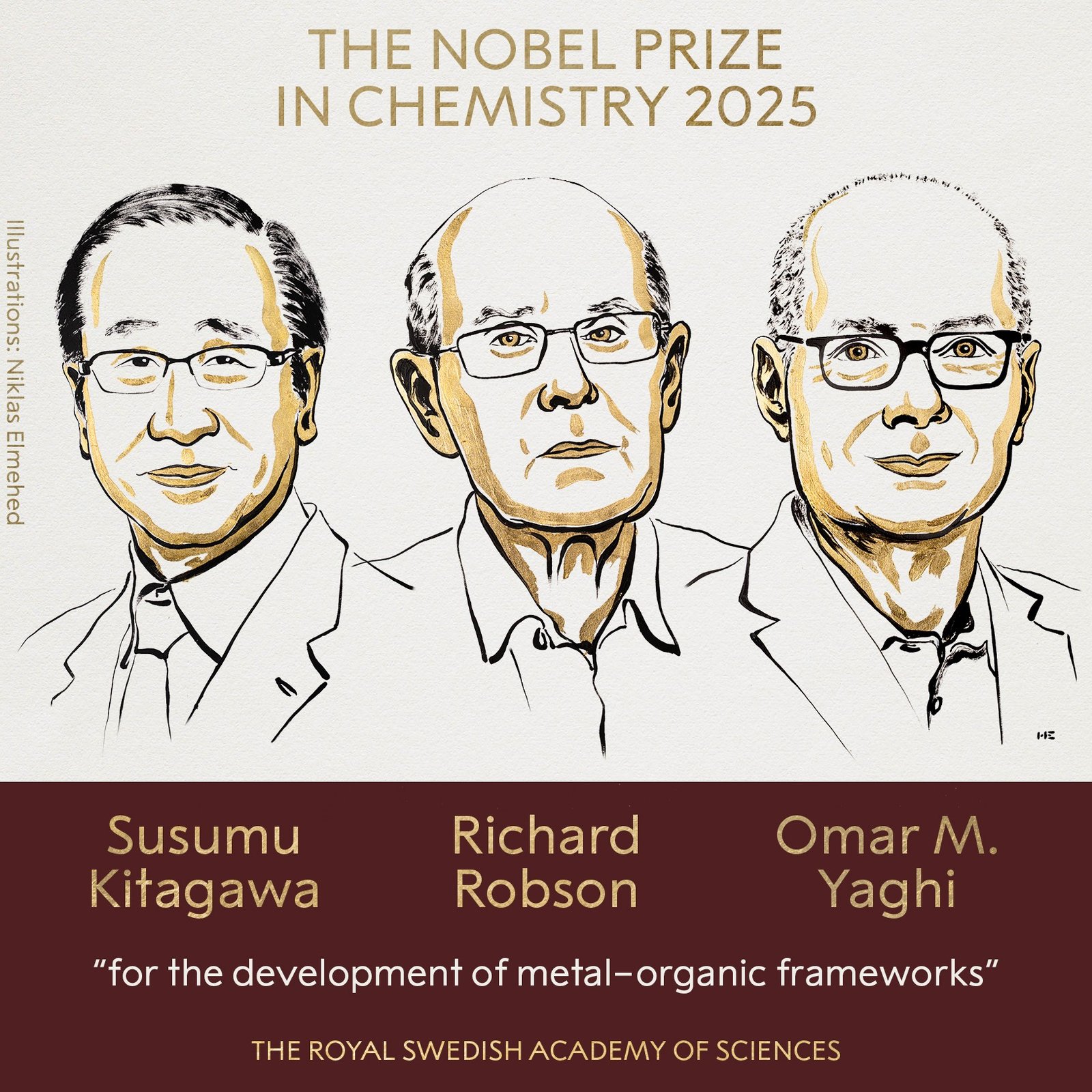
The 2025 Nobel Chemistry Prize has been awarded to Japanese scientist Susumu Kitagawa, British researcher Richard Robson, and Jordanian Omar M. Yaghi by the Royal Swedish Academy of Sciences. They will share the 11 million Swedish crowns (approximately $6.2 million) prize for their groundbreaking work on metal-organic frameworks (MOFs), porous materials that can capture, store, and separate molecules at the atomic level. These structures show promise in transforming our understanding of matter and driving forward new technologies.
Imagine an atom-built sponge – that’s how metal-organic frameworks (MOFs) work. These frameworks consist of metal ions (like copper, zinc, or cobalt) connected to long organic chains, forming a crystal with countless microscopic pores. These ‘holes’ are so tiny and well-organized that they can capture gases, store energy, or separate specific molecules, essentially enabling ‘empty space engineering’ within chemistry.
MOFs are incredibly porous, with a few grams of the material possessing an internal area equivalent to a football field. This means they can absorb immense amounts of gas or vapor compared to other materials. ‘These structures have enormous potential, creating unprecedented possibilities for tailor-made materials with new functions,’ explained Heiner Linke, Chair of the Nobel Chemistry Committee.
The research began in the 1980s when Richard Robson observed the potential of using the natural attraction between metal ions and organic molecules to develop crystals with internal cavities. Later, Susumu Kitagawa from the University of Kyoto demonstrated the stability and flexibility of these materials, showing they could absorb and release gases without disintegrating. Omar Yaghi, from the University of California, Berkeley, then developed ultra-resistant versions like MOF-5, which remains intact even at 300°C and can be molded for specific uses.
Yaghi showcased one of the most significant applications: extracting water from desert air. His team created a material that captures water vapor overnight and releases liquid when heated by sunlight. While still mainly studied in laboratories, MOFs already show real and promising applications, from capturing CO2 in factories to purifying water by retaining pollutants like PFAS and remnants of drugs.
Since the original discoveries, scientists worldwide have developed thousands of MOF variations, each with specific properties to tackle different challenges. These materials hold the potential to address issues ranging from climate change mitigation to the creation of more efficient medications and batteries. By creating ‘new rooms’ within molecules, Kitagawa, Robson, and Yaghi have paved the way for chemistry to find innovative solutions to humanity’s major problems.





Deixe um comentário