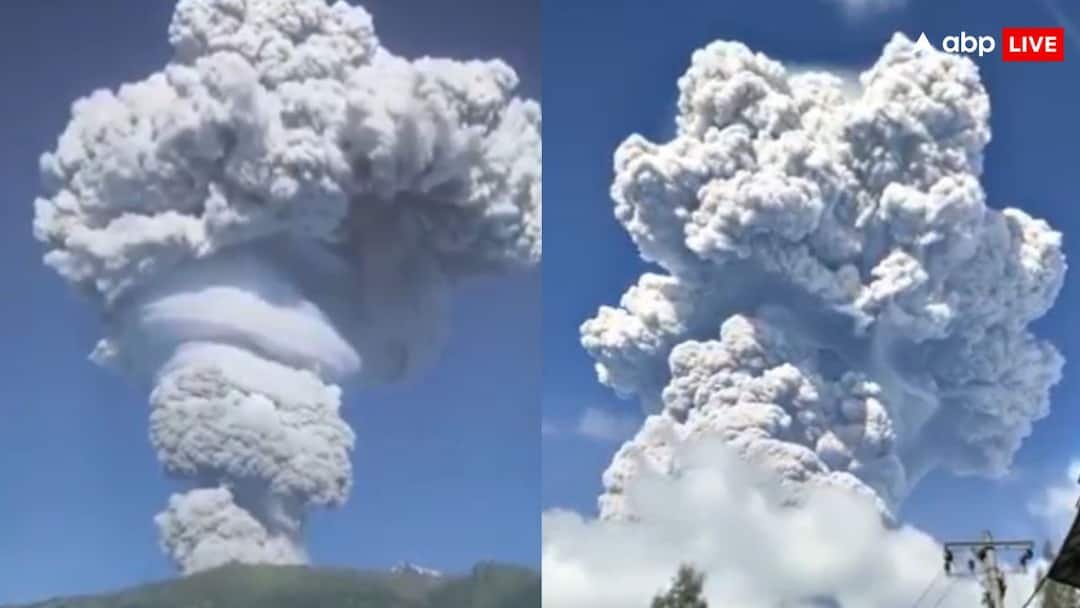
The volcano was peaceful… extremely peaceful, having been dormant for almost 12,000 years, but suddenly it erupted. The eruption was so intense that its smoke reached India, crossing rivers, streams, seas, oceans, mountains, and plains, even reaching the capital city of Delhi, where, for a few hours, the city was covered in ash. Now, the smoke has dispersed. The sky in Delhi is blue again, but people are questioning why a volcano that had been peaceful for 12,000 years suddenly erupted.
Rising ash pile nearly 15 km high
Ethiopia, the only African country never colonized by Europe, is home to around 110 million people. In this country, a dormant volcano that had been sleeping for 12,000 years suddenly erupted. The sulfur dioxide and ash from its eruption reached heights of nearly 15 km, transformed into smoke that crossed the Red Sea, passed through Yemen and Oman, reached the Arabian Gulf, crossed from Pakistan into India, and eventually made its way to China.
Delhi faces the heat from the erupting Helle Gubbi volcano
The eruption responsible for the havoc is the Helle Gubbi volcano located in the Afar region of Ethiopia. While no human casualties resulted from its eruption, the ash that has spread has caused some discomfort for people wherever it has reached. Flights along this route have either been canceled or diverted for a while, as the ash could have damaged the flights’ engines. In India, 11 flights had to be canceled because the ash had reached Delhi. The biggest question remains: why did the Helle Gubbi suddenly erupt?
Why did the Helle Gubbi volcano erupt?
The concept is similar to what one experiences with a chimney in their kitchen. When cooking, smoke fills the house and needs to be vented out through a chimney. Just like a chimney, a volcano is the Earth’s own vent. Inside the Earth, there is hot lava, gas, and ash. The hot lava is very light and tries to come to the surface.
When the Earth’s tectonic plates collide, the lava tries to reach the surface, causing the Earth’s upper crust to break and the lava spills out, shaping into a mountain-like structure known as a volcano. In simple terms, a volcano is like a chimney for the Earth.
12,000-year-old dormant volcano suddenly erupts
While the exact reason for the eruption of the Helle Gubbi volcano remains a mystery, as it had been peaceful for the past 10-12,000 years, generally, volcanic eruptions result from the movement of the Earth’s tectonic plates. As the plates move, pressure builds up within the volcano, causing it to erupt because the volcanic pressure increases as the plates move, seeking a release point on Earth’s surface.
The Helle Gubbi is part of the Erta Ale volcanic chain, located in the Afar Rift, where the Earth’s tectonic plates are constantly shifting. Due to the calmness of the Helle Gubbi, it was not being monitored like its neighboring volcano, Erta Ale. The magma wall beneath the Erta Ale, a part of the volcanic chain, has ruptured due to seismic activity, measuring 4.7 in magnitude.
Challenges for locals in Ethiopia
The eruption poses a significant challenge for both locals and scientists as they ponder what comes next. Small farmers and herders are the most affected. The Afar region of Ethiopia, where the volcanic eruption occurred, is a desert area with small villages. Ash has settled in these villages, posing a threat to livestock feed availability. If the ash is not removed promptly, grazing animals could be at risk of starvation. Another challenge will be for people with respiratory issues, as the ash dispersed by the volcano could cause breathing difficulties.
Golden opportunity for scientists
For scientists, this is a golden opportunity to deepen their understanding of volcanoes in a better way. They will try to unravel why a dormant volcano that had been peaceful for 12,000 years suddenly erupted. In other parts of the world, where volcanoes have remained silent for long periods, the mystery behind their silence will also be explored.





Deixe um comentário