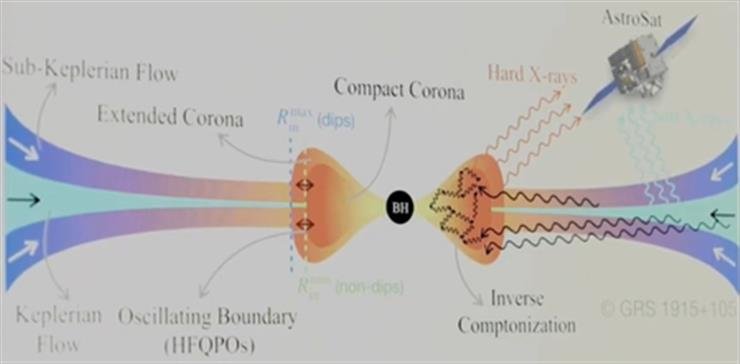
NEW DELHI: A multi-institutional team of scientists from the Indian Space Research Organisation (ISRO) and the Indian Institute of Technology (IIT) Guwahati has successfully decoded a puzzling X-ray signal pattern coming from a black hole situated approximately 28,000 light-years away from Earth. This groundbreaking discovery sheds light on the behavior and characteristics of distant black holes.
The team’s findings have revealed an unusual flickering pattern in the X-ray emissions from the black hole, challenging previous understanding of how these cosmic entities interact with their surrounding environment. By analyzing these intricate signals, the researchers have gained valuable insights into the intricate dynamics of this distant black hole and its emission processes.
The collaboration between ISRO and IIT Guwahati underscores the importance of interdisciplinary research in unraveling the mysteries of the universe. By combining expertise from space exploration and technological innovation, the team has pushed the boundaries of astrophysical knowledge and deepened our understanding of celestial phenomena.
This groundbreaking research opens up new avenues for studying black holes and their behaviors, paving the way for further discoveries in the field of astrophysics. The insights gained from this study could have far-reaching implications for our understanding of the universe and the fundamental laws governing its nature and evolution.
Understanding the intricate X-ray signals emanating from black holes allows scientists to probe the underlying physics of these enigmatic cosmic objects. The collaboration between ISRO and IIT Guwahati highlights the significance of international partnerships in advancing scientific research and expanding our knowledge of the cosmos.
As the scientific community continues to delve deeper into the mysteries of the universe, collaborations like the one between ISRO and IIT Guwahati play a crucial role in driving innovation and expanding our understanding of the cosmos. This latest discovery marks a significant milestone in astrophysical research and sets the stage for further groundbreaking studies in the future.





Deixe um comentário