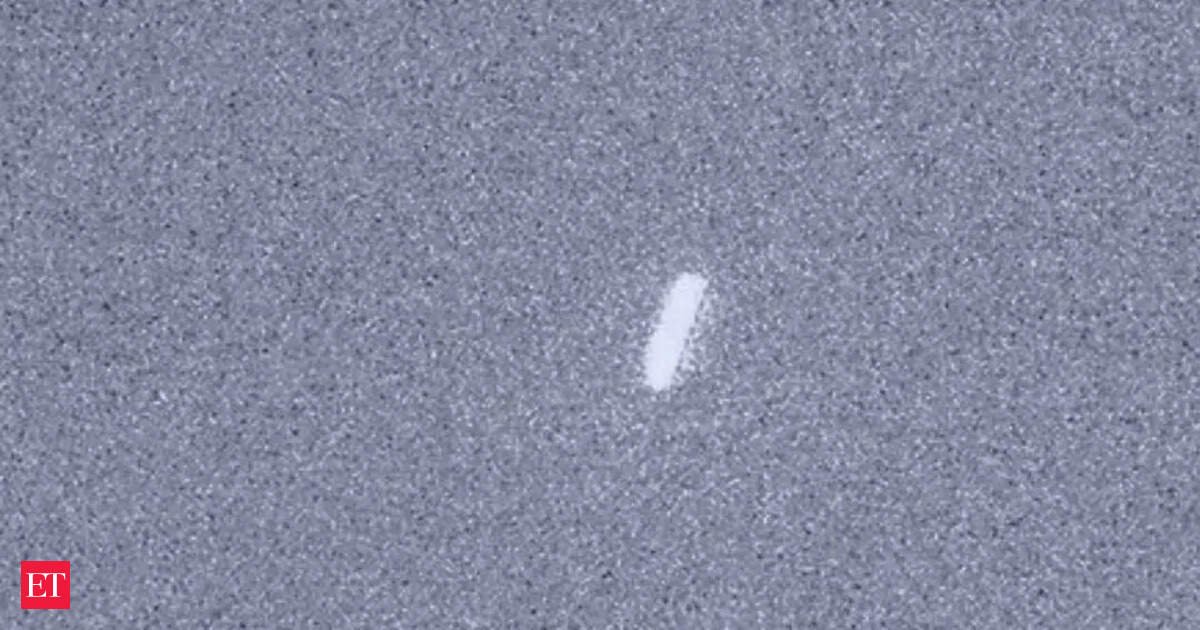
The interstellar object 3I/ATLAS has caught the attention of scientists with its unexpected detection of nickel vapor, leading to speculations about its origins and composition. NASA and the International Asteroid Warning Network (IAWN) are closely monitoring the object as it traverses the solar system, aiming to unravel its mysteries. Initial findings have revealed anomalies in its chemical emissions and orbital behavior, prompting further investigations into its composition and potential technological connections.
The discovery of 3I/ATLAS has spurred global interest, with scientists from NASA and various observatories working together to analyze its peculiar characteristics. Its emission of nickel vapor, coupled with its unique motion and evolving tail, presents a puzzle that challenges existing scientific knowledge about cosmic objects. As researchers delve deeper into the object’s properties, theories about its possible alien origins and advanced technology continue to circulate.
3I/ATLAS, the third confirmed interstellar object after ‘Oumuamua and Borisov, was first spotted in 2025 by the ATLAS system. Despite NASA’s silence on the matter, reports suggest that the agency activated defense systems in response to the object’s unusual behavior, including sudden accelerations and a perplexing ‘anti-tail’ phenomena pointing towards the Sun.
The surprising detection of nickel vapor in 3I/ATLAS’s gas cloud at extreme distances challenges conventional understanding of metal vaporization in cold environments. Scientists using the Very Large Telescope have identified nickel tetracarbonyl, a compound not typically found in natural comets, hinting at a potentially manufactured origin. The absence of iron in the emissions adds another layer of complexity to the object’s composition.
Harvard astrophysicist Avi Loeb has raised alarm about 3I/ATLAS, suggesting it could represent a significant cosmic event with implications beyond current comprehension. Loeb’s hypothesis of the object being of artificial origin, possibly an alien probe, has sparked intense debate within the scientific community. The object’s massive size and inexplicable acceleration only add to the mystery surrounding its true nature.
Observations from the Hubble Space Telescope and ground-based facilities have revealed a hazy coma forming around 3I/ATLAS, indicating the release of gas and dust particles as it approaches the Sun. The abundance of carbon dioxide relative to water in the surrounding gas further underscores its unique characteristics, pointing towards an exotic formation environment outside our solar system.
As 3I/ATLAS makes its closest approach to the Sun in October 2025, researchers anticipate shifts in its activity and emissions, offering a rare opportunity to study interstellar materials up close. By comparing its data with other interstellar objects like Borisov, scientists hope to gain insights into the diversity of planetary building blocks across different star systems. The ongoing monitoring of 3I/ATLAS promises to enrich our understanding of interstellar comets and the complex chemistry shaping distant solar systems.





Deixe um comentário