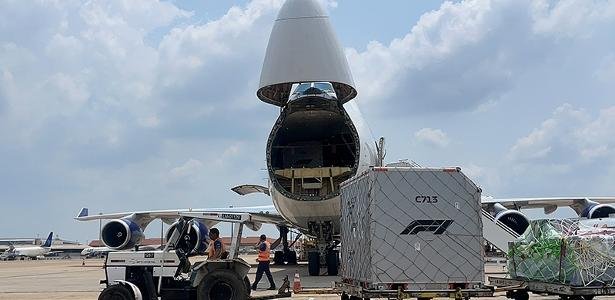
The Brazilian logistics scheme does work: the most ‘precious’ cargo, the cars and engines, the eight tons of broadcasting equipment, among other items, arrive at Viracopos Airport and are escorted to Interlagos. The rest – garage panels and cheaper items – come by sea, just like in all races outside Europe. The issue lies in the fact that the Formula 1 calendar is inflated, filled with commitments for several reasons, and Brazil is far from all other stages, while the category aims to meet sustainability goals.
This is the reason why the Brazilian stage has occupied two different positions over the past few years, which doesn’t affect the date for the fans much, but represents a significant change in terms of the logistics of those who work in the sport: sometimes the stage is ‘isolated’, with no races before or after, and other times it’s part of a ‘triple header,’ three races in three consecutive weekends.
This year, the GP has no ‘neighbors.’ It will take place about two weeks after Mexico and two weeks before Las Vegas. In 2026, it will be the last leg of the sequence, starting in Austin, United States, then going to Mexico City.
And the consensus is that there’s no perfect way to fit Brazil into the current calendar: either you save on travel time and generate enormous fatigue for those working in the sport. Or people cross the Atlantic Ocean four times and avoid working continuously for three weeks.
Yes, there are two ways to look at it. If you give a week off, people fly back home, which you can say is better for the body, but from a sustainability point of view, they have to fly back for the next race. With the three consecutive races, there’s a much shorter window, reducing the passengers’ carbon footprint.
Paul Fowler, vice president of motorsport at DHL, F1’s logistics partner, to UOL Esporte.
In terms of equipment, nothing changes, as regardless, the cars go from Mexico to Brazil and from Brazil to Las Vegas, no matter how the calendar is organized. There are also three sea shipments anyway: what was in Austin is then taken to Las Vegas. There’s a second for Mexico and a third for Brazil. This can’t be changed due to travel deadlines. Throughout the season, five to six different sea shipments are used to attend all 24 races.
For DHL, which provides all the logistics solutions for F1 and all its equipment to set up the paddock, VIP areas, and everything needed to broadcast the images worldwide, the teams, and even the TV broadcasters covering the sport live, the triple headers mean that there are three teams working at each of the locations where F1 runs almost simultaneously.
For us, and many teams are adopting this, each employee can choose not to go to three races a year and, if chosen wisely, can avoid the triple headers. Many teams now, including us, will have an assembly team, a racing team, and a disassembly team. The problem with the triple headers is that there will be a time when you’ll need three people [one in each location].
Paul Fowler
Explain: the materials that arrive by ship will be assembled by a team completely different from the mechanics who will work during the race weekend. They start going to the track on Wednesday before the race to assemble the car, which will be finished on Thursday to run on Friday. They’ll disassemble the car on Sunday night for faster airlift, and a third team will arrive later to pack the panels and everything else in the containers for sea shipment. From Brazil, everything will return to the factories to be refurbished for the following year.
So logistically, considering sustainability, everything has already been much more rationalized compared to earlier times, and Fowles’ parallel is spot on, saying ‘teams were moving the entire house just to fix a washing machine.’ The current problem, and for F1 to achieve its zero-carbon goal by 2030, from a logistics standpoint, is more about managing people’s travel.
When the cars almost weren’t ready in Brazil
So, from that perspective, it’s better to do Austin, Mexico, and Brazil without ‘breaks,’ right? But there are risks. Especially regarding long distances, like the 7400 km between Mexico City and Sao Paulo, in a short amount of time. The car shipment travels on Monday when three planes – F1 uses eight 777 planes to transport equipment – had delays departing from Mexico in 2021.
Yes, it was tight. The issue was a cargo weight problem for the plane to take off with much fog, requiring fuel removal. However, due to Mexico’s altitude, it wasn’t viable, so we needed to wait for the right window and fly closer. We flew to Miami for refueling to reach Brazil.
We arrived on Thursday. Car assembly usually happens on Wednesday. There’s a curfew and everything else. But we have the opportunity to go to the FIA and say it was a force majeure event to extend the curfew and not put that pressure on the teams. It’s an option we have, don’t like using it much, but in this case, we had no choice.
Paul Fowler
It’s no accident that there’s talk in the paddock that Brazil could return to the beginning of the calendar. However, there’s still no ideal solution. The season has been starting in Oceania, then East Asia and the Middle East due to Ramadan dates. Normally, it would start in the Middle East itself. It’s challenging to find a logical way to include Brazil there.
But the GP organizers say they are open to a date change if necessary. ‘It’s more a logistical issue for F1 itself and fitting into the city’s major events calendar. Either way, we’re always open to improving the F1 experience in Sao Paulo,’ said Alan Adler, CEO of the Sao Paulo GP, to UOL Esporte.





Deixe um comentário