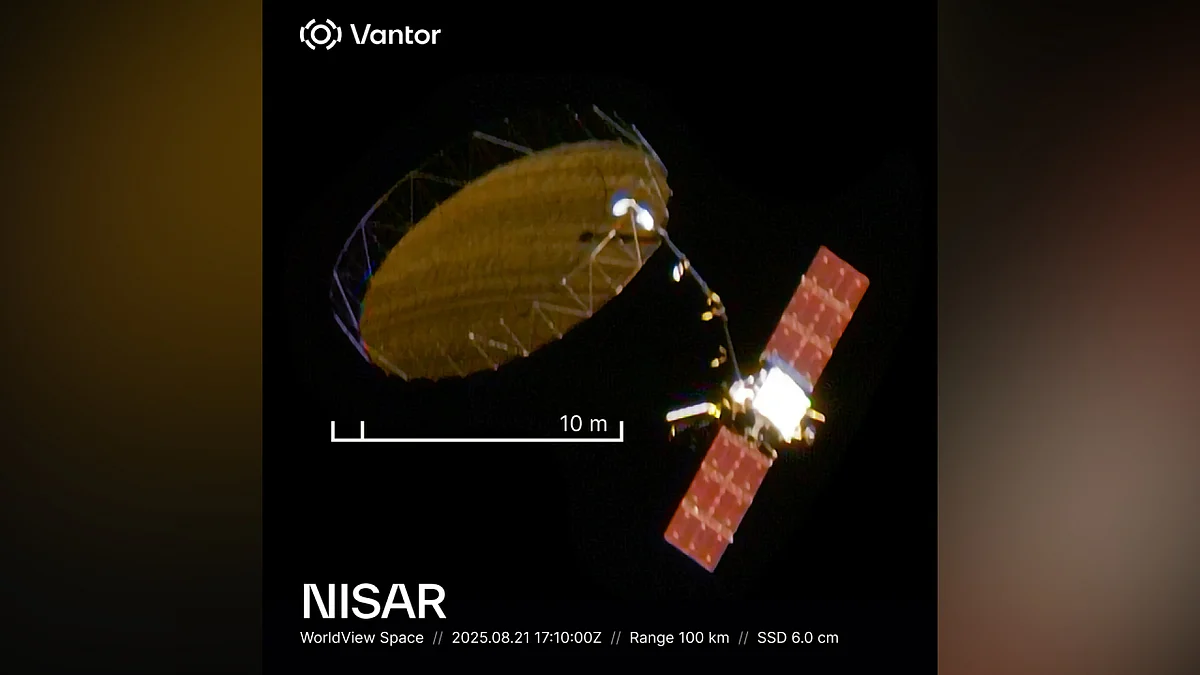
BENGALURU: Vantor, previously known as Maxar Technologies, recently delighted space enthusiasts by sharing a captivating image of the NASA-ISRO Synthetic Aperture Radar (NISAR) captured in space. The satellite, known for its advanced capabilities, was photographed from Earth’s orbit. This achievement highlights Vantor’s expertise in providing AI-powered spatial intelligence solutions.
The image of NISAR in space quickly gained attention on social media after Vantor shared it on their platform. The satellite, which is a joint collaboration between NASA and ISRO, plays a crucial role in Earth observation and monitoring. Its advanced Synthetic Aperture Radar technology allows for high-resolution imaging and data collection for various applications, including disaster management, agricultural monitoring, and climate studies.
Vantor’s ability to capture such a clear and detailed image of NISAR demonstrates the company’s commitment to pushing the boundaries of spatial intelligence. The precise observation capabilities of NISAR make it a valuable asset for researchers and scientists around the world. By harnessing the power of AI, Vantor continues to provide cutting-edge solutions for understanding our planet and its dynamics.
The photograph of NISAR in space serves as a reminder of the incredible advancements in space technology that enable us to explore and study the Earth more effectively. Vantor’s dedication to capturing and sharing such images showcases the importance of collaboration and innovation in the field of spatial intelligence. The integration of AI technologies with satellite imaging is revolutionizing how we collect and analyze data for a wide range of applications.
As we marvel at the beauty of the NISAR satellite captured in space, we are reminded of the endless possibilities that space exploration offers. Vantor’s role in capturing this image highlights the company’s position as a leader in providing advanced spatial intelligence solutions. The partnership between NASA and ISRO continues to yield groundbreaking results that benefit not only scientific research but also our understanding of the world we live in.





Deixe um comentário