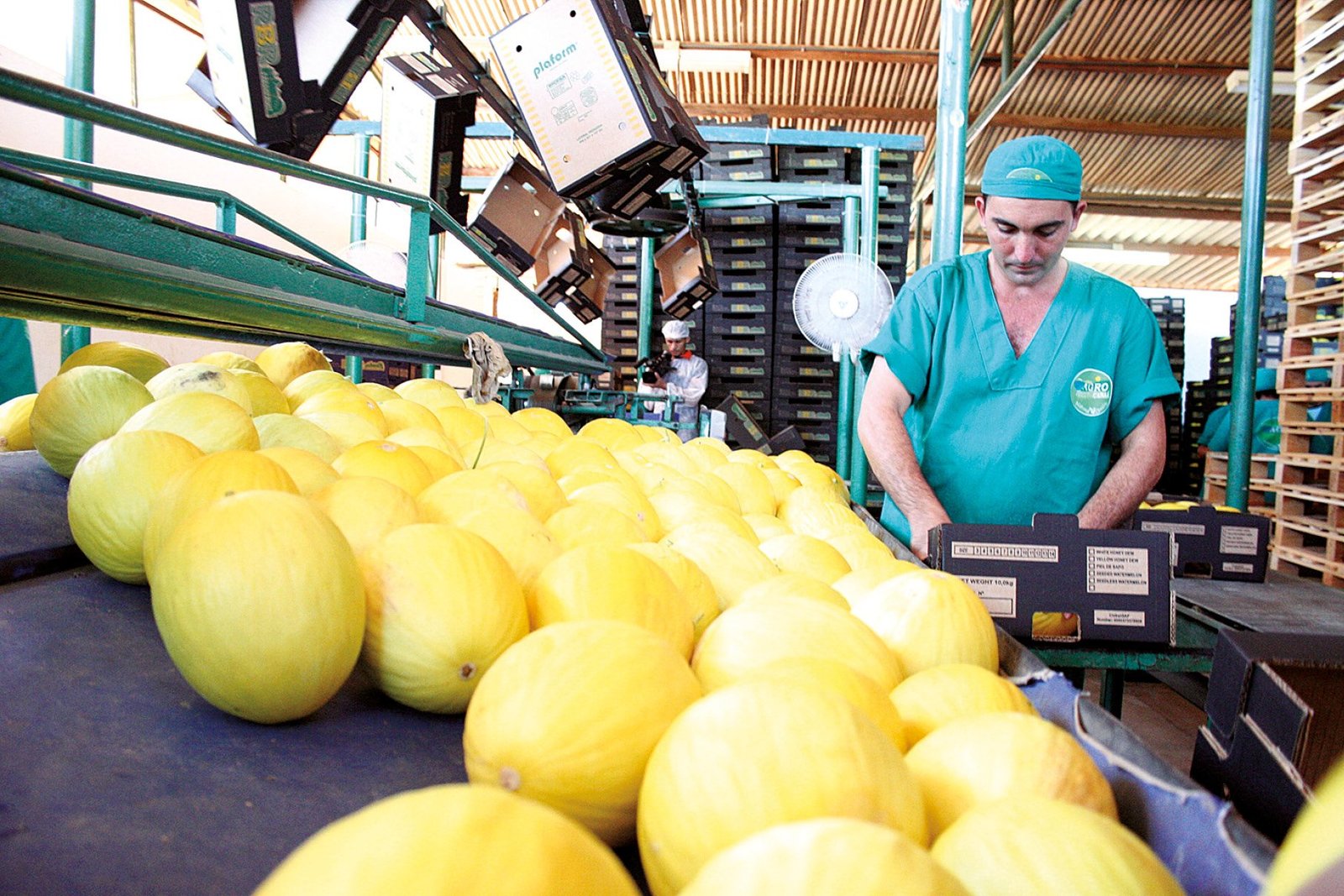
Rio Grande do Norte has conquered two new markets for melon exports: Indonesia and Malaysia. The opening of these new export destinations was announced after an official Brazilian government mission carried out between October 23 and 28 to the respective countries. The productive sector in Rio Grande do Norte views the announcement with optimism, but assesses that exports will not be possible initially due to logistical and infrastructure difficulties.
Fábio Queiroga, president of the Executive Committee of Fruit Growing in RN (COEX), states that despite the opening of markets like Indonesia and Malaysia, the state lacks the necessary infrastructure to meet the demand of these new destinations. ‘We do not have the logistics available for these markets, so there is no prospect at the moment,’ he said.
According to Guilherme Saldanha, Secretary of State for Agriculture, Livestock, and Fisheries, it is possible to meet the demand: ‘I believe that we may need to produce an additional 20 to 25 thousand hectares of melon. This obviously means about 50 thousand formal jobs,’ he states.
He explains that the solution to this problem is to establish a direct route with the aim of reducing transport time to around 28 to 30 days. If the fruit arrives within this timeframe, it will be in suitable conditions for distribution and commercialization, maintaining its quality for consumption.
The expectation is that next year it will be possible to test a smaller ship on a direct route, without intermediate stops. Currently, there is already an export route through the Port of Pecém, but with a still long transport time of around 42 days, although it previously exceeded 50 days. Ships used to sail to a port in Europe, then to the Middle East, and only then to China, causing the fruit to arrive in unsuitable conditions for commercialization and consumption.
Alan Silveira, State Secretary for Economic Development (Sedec-RN), emphasized the importance of opening up new markets for melon from Rio Grande do Norte. ‘The opening of new markets is fundamental for economic development; it drives growth, increases productivity, creates jobs and income, and strengthens the trade balance,’ Silveira stated.
Although an agreement to open the Chinese market for melons from Rio Grande do Norte was signed six years ago, in October 2019, RN has not effectively taken advantage of this market yet. The difficulty, once again, lies in logistical issues.
Fábio Queiroga explains that the main obstacle is related to the unavailability of shipping companies to open routes from ports near RN to China. ‘We will possibly only have this route when there are Chinese companies established in our region, receiving materials from China, enabling the transit of ships with cargo in both directions,’ Queiroga said.
He also analyzes that with the establishment of a direct maritime route between China and Brazil, it would be possible to serve markets like Indonesia and Malaysia from this same navigation route. ‘With a maritime route from our coast to China, it could serve these two countries with the same route,’ he stated.
Secretary Alan Silveira (Sedec) reported that, to solve the issue, the Port of Natal is undergoing renovations through a recent agreement signed to carry out dredging of the terminal, in addition to works on pontoon defenses, reform of warehouses, and installation of a photovoltaic plant.
The dredging of the Port of Natal, budgeted at R$60 million, is in the bidding process, with funds already secured. The project aims to increase the depth of the port’s access channel to operate larger ships, essential to meet the growing demand for fruit and other exports.
Guilherme Saldanha emphasized that the viability of new export routes, including the possibility of increasing the number of ships, depends on commercial decisions between buyers and sellers. ‘This export issue involves a lot of commercial and private decisions between buyers and sellers,’ he stated.
RN has potential in fruit growing.
The melon is the main export product of RN and, for the 2025/2026 harvest, the expectations are high. The Port of Natal expects to handle up to 300 thousand tons of fresh fruits, a volume representing double the amount exported in the previous harvest.
‘Our state is very strong in irrigated fruit growing and we already export to several countries. This competition in global markets stimulates the innovation and improvement of our products and services,’ the Secretary highlighted.
In 2025, RN expanded its presence in international trade. Seventy-five countries were reached, with the conquest of eight new markets including Georgia, Mauritania, Sweden, and Ukraine.
Secretary Guilherme Saldanha believes that RN’s geographical location also favors the sector: ‘Rio Grande do Norte has a spectacular geographical position. We have water security, we have roads that allow us to efficiently channel the production.’





Deixe um comentário