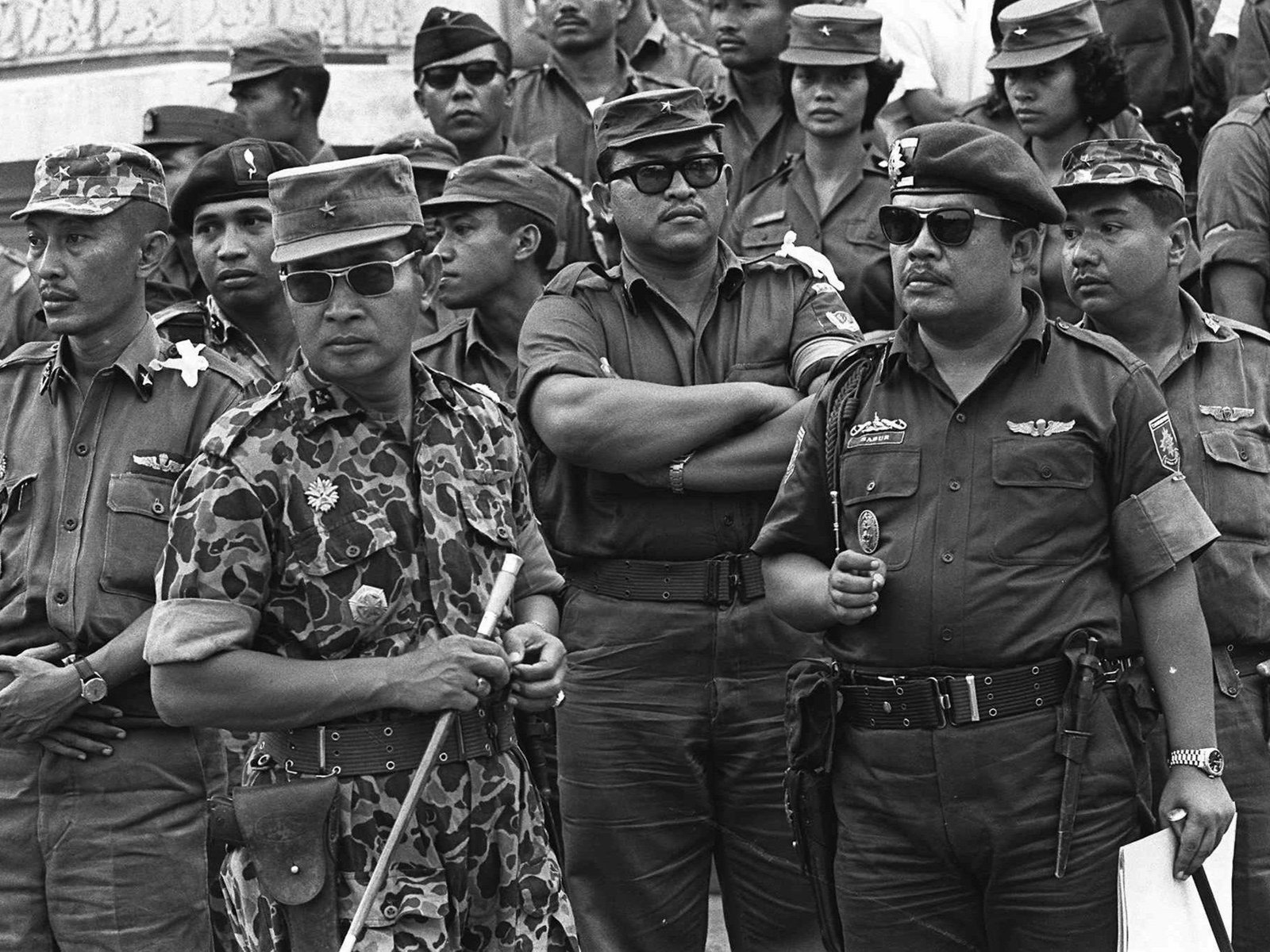
On the night of September 30, 60 years ago, a paramilitary command in Jakarta, the capital of Indonesia, kidnapped and killed six high-ranking Army officials. The response was swift: led by General Suharto, the military took control of the government and unleashed a massacre across the vast geography of the country, one of the largest and most populated in Asia, for several months, supported by paramilitary organizations.
Until then, Indonesia was ruled by Sukarno, a nationalist who had leaned towards the left and had presided over Indonesia since its independence two decades earlier. The military kept him in the presidency for a while, without power.
In 1967, Suharto assumed power to establish a virtual dictatorship that would last for three decades. Sukarno, confined to his house, died in 1970. Known by his supporters as Bung Karno (Brother Karno), his last wish was to have the epitaph: “Here lies Bung Karno, the voice of the Indonesian people”.
All of this may seem very distant to us today, both in space and time, but it is important to set the context: almost a decade ago, an International Court in The Hague reviewed the case and described the massacres in Indonesia as “one of the largest genocides of the 20th century” and a “crime against humanity”.
It is estimated that between half a million and a million people were killed, in a rampage of bullets, hacking, strangulation, and stabbings that would later be imitated in other geographies: Cambodia under Pol Pot in the 1970s, Rwanda, and the former Yugoslavia in the 1990s, among the most remembered.
The then Indonesian president, Suharto, is pictured in 1998 when he announced that he would step down from power after parliamentary elections. Photo: AFP
The Destruction of the Communist Party
But the Indonesian military achieved their goal: the Communist movement in Indonesia was completely wiped out. The Communist Party of the country had 12 million members, making it the third largest in the world (only the Communist Parties of the superpowers of that era, the Soviet Union and China, were larger).
The Communist Party was a powerful force in Indonesia in the 1960s, on par with the military and Islamists. And Sukarno acted as a balance between all of them. At the time, his name resonated in the midst of a wave of Third World movements – Sukarno was mentioned in Asia as a Lumumba in Africa or a Fidel Castro in America – but his shift to the left made him a threat to the United States and Western powers. Furthermore, Sukarno blamed the US for the spread of the war in nearby Southeast Asia: Vietnam, Laos, Cambodia.
Sukarno was born in 1901, the son of a teacher linked to the Hindu religion. He received a privileged education in a country that was still a Dutch colony, where the vast majority of the population suffered from poverty. Sukarno mastered six languages and graduated as an engineer and architect, establishing his design studio, where he was commissioned to work on significant projects, from residences to monuments.
But at the same time, he ventured into politics: he founded the Indonesian Nationalist Party with the goal of gaining independence from the Dutch crown. He was exiled to Sumatra, where the Japanese came to his aid. With the end of World War II – including the collapse of Japan – Sukarno and his supporters seized the opportunity and declared independence on August 17, 1945.
Sukarno’s government, after starting as a parliamentary democracy, was characterized as a “guided democracy” (perhaps a precursor to modern populism), but there were advances in modernizing the country. Sukarno resided in the Bandung Palace and became one of the leaders of the Non-Aligned Movement in the 1960s: he welcomed figures like Nehru and Nasser, Chou En-lai, and Ho Chi Minh.
The Massacre
But his shifting alliances led to that fateful September night and the immediate massacre. Suharto emerged as the strongman and established the “New Order,” dissolved the Parliament, while death squads eradicated any trace of the left. In that bloody orgy (the military’s argument was to “prevent a Communist Party coup”), they also targeted religious minorities: Christians, Chinese, and Hindus.
The “purge” began in Jakarta but spread to Java and reached the tourist paradise of Bali. Indonesia is a massive archipelago where dozens of ethnic groups coexisted: it had 100 million inhabitants at the time, a number that has tripled since then. And today, Jakarta is the most populous city in the world, with 40 million inhabitants.
A military guard stands in front of Suharto’s house in Jakarta after his death in January 2008. Photo: REUTERS
The massacre had an active involvement of a paramilitary organization called Pemuda Pancasila, which later transformed into a powerful political (with officials and parliamentarians) and mafia group (extorting ethnic minority traders).
For several decades, outside Indonesian borders, the massacre was remembered, and mentioning “Jakarta” was enough to evoke fear in any revolutionary movement.
Post-massacre Indonesia faced new conflicts, such as nationalist movements in Papua New Guinea (1979) and East Timor (1983), sites of other killings. Also, natural disasters – the devastating 2005 tsunami – or, in the socio-political realm, the 1997 economic crisis, the rise of Islamism, and the growing Chinese influence.
The Carnage in Cinema
A direct heir of that era – as he rose to the rank of general – is the current President Prabowo Subianto, who won the elections last year.
The events of ’65 were only brought back to light by the documentary “The Act of Killing” (2012), by American filmmaker Joshua Oppenheimer. It shows the killers boasting about their crimes: “We beat them to death, and there was an ugly bloodstain, so we started using wires,” one of them said.
The BBC interviewed the filmmaker and asked how such a massacre seemed to be forgotten: “It’s as if Hitler had won World War II and Himmler was a national hero, savior of the country. In Indonesia, winners still have a lot of power and all the impunity in the world to perpetuate their version of events,” he replied. He later made a second documentary, “The Look of Silence,” giving voice to survivors and families of the victims.
The filmmaker, who was Oscar-nominated for his first documentary, explained that he “does not intend to be a historical chronicle but an exploration into the dark psyche of a country that has self-justified its exercise of the atrocious, a journey into the heart of darkness that adopts the strategy of therapeutic dramatization to bring guilt to the surface.” Oppenheimer’s documentaries led to the establishment of the aforementioned International Court in The Hague. There, in addition to considering the United States, Australia, and Great Britain as “accomplices” of the Suharto regime, they requested that Indonesia acknowledge what had happened. However, successive Indonesian governments did not revisit that past, barely mentioning it as an “event”.
Six Decades Later, Indonesia Remembers the Horror of One of the Largest Genocides of the 20th Century

-
Flamengo and PSG have faced each other three times; check out their record
-

Indonesia Open Footgolf Tournament: Comedian Oki Rengga Admits Addiction, Wants to Become a Professional Athlete
-

Shameful Incident in Punjab! Landlord Rolls Tenant’s Daughter
-
Virgil van Dijk Expresses Desire for Mohamed Salah to Stay at Liverpool
Deixe um comentário